
Clay County Deed Types
The Clay County Chancery Clerk files far more than plain sale deeds. Instrument type tells you what changed, and just as often what did not. A warranty deed conveys land with stated assurances. A quitclaim passes only whatever interest the grantor holds, if any. Estate and trustee instruments tend to follow a death. Others trace back to a court action or a security process. Read the document itself. No label can capture every condition, exception, reservation, or legal description buried in the fine print.
| Deed Type | What It Does | Common Use |
|---|---|---|
| Warranty deed | Conveys the described interest with stated title covenants | Ordinary purchase transfer |
| Quitclaim deed | Passes whatever interest the grantor holds without broad assurances | Family or interest cleanup |
| Special warranty deed | Uses narrower assurances tied to the grantor's period | Limited-covenant transfer |
| Executor or personal-representative deed | Conveys through estate authority | Probate sale or distribution |
| Trustee or substitute-trustee deed | Records a transfer by a trustee under stated authority | Trust or secured-debt process |
| Tax deed | Records a transfer arising from the tax-sale process | Delinquent-tax land |
A deed of trust is not a deed that sells ownership. It secures an obligation. Releases, cancellations, assignments, construction liens, lis pendens, easements, and judgments can all mark the land record. None of them requires a conventional sale. Clay's index also carries mineral, timber, cemetery, life-estate, transfer-on-death, and trust instruments.
Search Clay County Deed Records
The Delta Deeds and Records Link serves as the online index. It belongs to the Clay County Chancery Clerk. Enter party names last name first. A partial-name control helps catch initials and spelling variants. Begin with one strong key. Then narrow by filing date, instrument type, legal land key, or recorded reference. The index itself warns users to review its indexing. It also states that its data is no substitute for an abstract or closing search. Treat it as a pointer to recorded instruments, not a title opinion.
| Index control | Accepted form | Practical purpose |
|---|---|---|
| Grantor or Grantee | Last name first | Locate deeds by a transferring or receiving party |
| Book Type / Book / Page | Dropdown and number fields | Retrieve a known recording reference |
| Filing Date | Month/day/year | Find a known recording day |
| Section / Township / Range | Separate land fields | Search rural descriptions |
| Subdivision / Block / Lot | Named dropdown and text | Find platted West Point-area land |
| Instrument Number | Year and number | Open a known indexed item |
| Instrument Type | Long refinement list | Separate deeds, liens, releases, trusts, and plats |
You can set both Include Grantors and Include Grantees to Yes. Results may be narrowed by book, filing-date, or instrument-number range, with 25 to 200 results shown per page. The index publishes no populated example row, so no party name, price, or book-and-page pattern should be inferred from the search screen.
See the Clay Deed Form
The official Clay County deed search screen shows its party, book, date, PLSS, subdivision, and refinement controls together on one form.
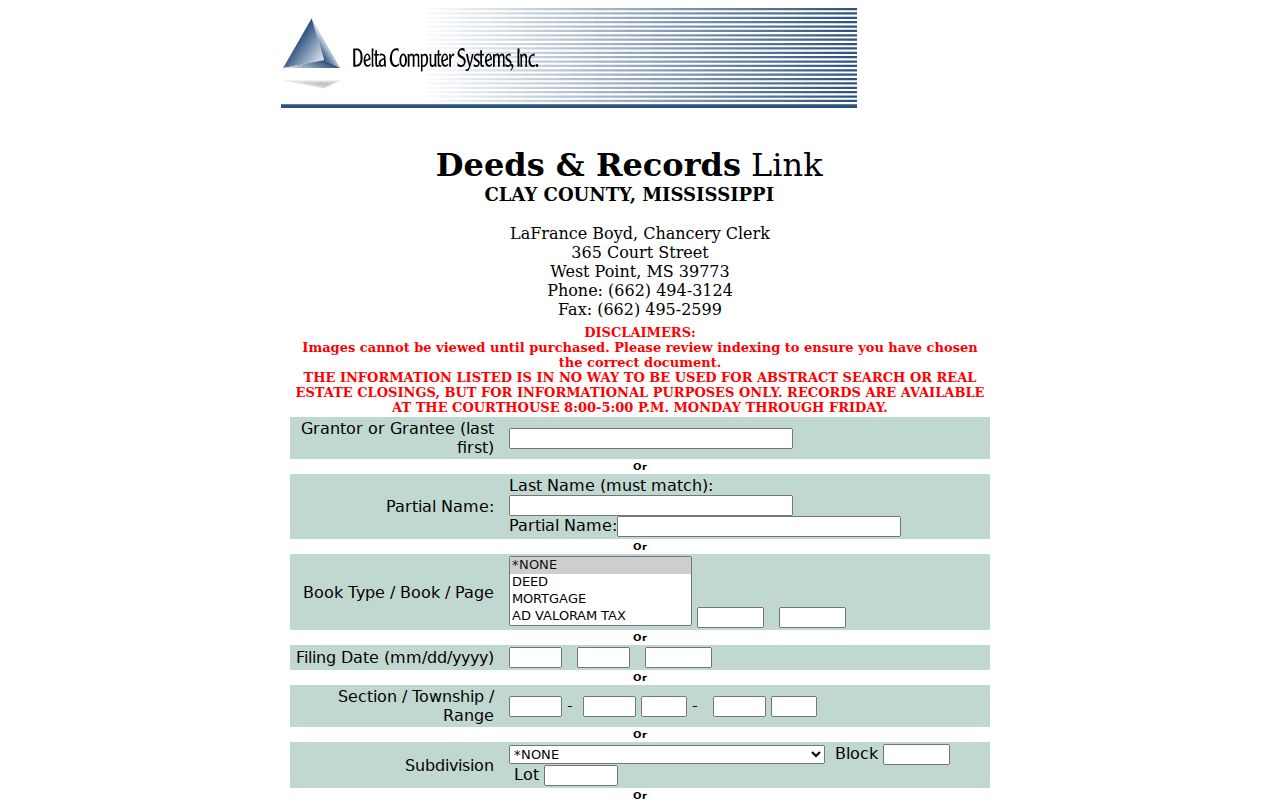
That layout explains why arriving with a legal description or recording reference helps so much. The form is built around parties and land-index keys, not a street address alone.
Clay Deed Coverage Cutoffs
Online coverage begins with deeds in 2007 and deeds of trust in 2011. Those are portal cutoffs, not the dawn of Clay County land ownership. A no-result before either year points you back to deed books and indexes. Plat cabinets and archival film fill the gap too. The Chancery Clerk's office remains the primary custodian throughout.
Coverage boundary. Clay County deed records before 2007 are not disproved by a blank Delta search. Continue at the courthouse and archival catalogs.
Clay County began as Colfax County in 1872 and took its current name in 1876. An older chain may need searches under both names, and land before 1872 can reach into predecessor counties. No courthouse fire or catastrophic records loss appears in any official account, so assume none occurred.
Follow Clay Grantors and Grantees
A grantor conveys an interest. A grantee receives it. Start from the best-known recent owner and carry the same parcel description through every step, because names alone can collide. The book-and-page cite, instrument number, subdivision lot, acreage, or section-township-range keeps the chain anchored to the right tract.
- Use the assessor owner and legal description to find that party as grantee on the most likely conveyance.
- Check the indexed parties, instrument type, recording date, book/page, instrument number, and land description before buying an image.
- Read the deed to identify the grantor who conveyed to the grantee.
- Search that grantor as an earlier grantee on the same land, testing initials, married names, estate terms, and entity variants.
- Repeat until the online cutoff, then move the last book/page and description to the courthouse index or microfilm.
- Grantor
- The party transferring the stated interest.
- Grantee
- The party receiving the stated interest.
- Chain of title
- The ordered sequence of recorded transfers tied to the same land.
- Book/page
- A volume and page reference used to retrieve a recorded instrument.
- Instrument number
- A year-number identifier assigned to a filing.
Refine Clay County Instruments
Delta's long instrument list can resolve breaks that a deed-only search misses. Estate terms include administratrix deed, administrator's deed, executor's deed, and heirship affidavit. The same group covers personal-representative deed, last will and testament, special commissioner, life estate, and transfer on death. Trust terms include certificate of trust, revocable trust, trustee's deed, and substitution of trustee.
Liens and notice records play different roles. A construction lien, federal tax lien, municipal lien, lis pendens, judgment, deed of trust, or UCC Land filing may flag a claim. It may also flag a secured interest. A cancellation, release, or partial release may later resolve it. Search the exact party and tract across those linked types. Do not treat the first adverse record as the final word.
Note: Check any court order or probate file in the Clay County land index. Look there for its final recorded deed or decree.
Clay Subdivision Index Quirks
The subdivision dropdown holds many local names, including Broadmoor, College Place, Highland Park, Lone Oak, Meadowhill, Old Waverly, Quail Ridge, River Oaks, West Point Commons, Westwood, and Woodland Hills. Phases and extensions often carry their own entries. Search each plausible version whenever a deed lists only a short neighborhood name.
Some options bear marks like unrecorded, revised, re-sub, NO INDEXING FILED, INDEXING IS INCORRECT, or LEFT BLANK INTENTIONALLY. Those labels describe the index, not legal title. When a label is uncertain, fall back on block and lot, inspect the plat, or return to the parent tract and its PLSS description.
Older Clay County Deed Books
Older Clay County deed chains live in the courthouse Deed Books and Plat Cabinets. The MDAH County Records on Microfilm catalog filters by county, series, volume, dates, index, and roll. Film is self-service in the MDAH Media Room. A separate pre-1920 county inventory points to still older series, though no complete Clay deed-book run appears there in one stable table.
MSU Special Collections holds West Point directories from 1965, 1967, and 1969, plus newspaper film. Those can hint at occupancy, estate notices, or address changes. They still do not replace the deed itself. Bryan Public Library's history room offers another local film source, but a machine-replacement effort planned for 2026 makes a call ahead wise.
Compare Clay Deed Access Costs
Online and courthouse access each suit a different kind of Clay County deed research. Delta works well for a focused, recent property records search. Images are paid only after the index is reviewed. A courthouse trip allows broad inspection of deed books without any remote subscription. Self-copying carries the lowest stated page rate. Staff copying costs more, and certification adds a fee the Chancery Clerk must confirm.
| Channel | Published charge | Best fit |
|---|---|---|
| Delta subscription | $30 monthly or $330 yearly | Repeated recent index and image work |
| Delta page access | $0.50 per page | A focused remote document |
| Courthouse self-copy | $0.25 per page | On-site inspection and selected copies |
| Clerk staff copy | $0.50 per page | A specific known instrument |
Mail is another direct channel once the book and page are known. Include payment and a stamped return envelope. For older or uncertain deed references, call first so staff can tell whether the item sits in an active index, a deed book, or another stored series.
Obtain a Clay County Deed
Delta images are purchased only after the index details are checked. The landing page lists $30 monthly or $330 yearly access, plus a $0.50-per-page route. For in-person deed records access, start with the Clay County Chancery Clerk land-record page. It posts weekday hours from 8:00 a.m. to 5:00 p.m. at 365 Court Street in West Point. Public self-copies run $0.25 per page. Staff copies are $0.50 per page. Certification costs extra. The Clerk publishes no exact added fee.
Mail requests to the Clay County office need a reasonably specific description and the book and page. Payment should come by check or money order. Include a stamped self-addressed envelope too. The office accepts cash, checks, and money orders payable to the Clay County Chancery Clerk. Call 662-494-3124 when the deed is old. The same number works when the index warning is unclear or certification is needed. Staff cannot give legal advice.
Recorded, not guaranteed. The Clay County deed index shows filed instruments. It is not a title opinion, survey, or guarantee that no unrecorded interest exists.
Mississippi's Public Records Act also permits a specific written request, subject to exemptions and actual costs. For an ordinary deed copy, rely on the Clerk's more precise land-copy procedure first. Ask for a written estimate before requesting any broad run.