
Inside Clay County Tax Records
Every Clay County tax record starts with the annual appraisal roll. The online result from Data Systems Management lists the property owner, parcel, tax year, physical address, city, ZIP, section, township, range, and AR tax status. Each field answers a different question. The parcel number is the best bridge across county systems. The tax year fixes the entry in time. Section, township, and range can rescue a rural search when a street address is thin. Treat the owner name as the roll's owner-of-record lead. It is not proof of current title after a recent sale.
| Field | What It Shows | Where |
|---|---|---|
| Owner and parcel | Annual owner name and the parcel key | Assessor roll |
| Land and improvements | Separate value components and total value data | Property card and state parcel layer |
| Tax year and status | The roll year and collection context | Assessor/Collector search |
| Exemption flag | Tax treatment shown for the account | Property card |
| Delinquency and sale | Unpaid-tax process, publication, sale, and redemption | Tax Collector and Chancery Clerk |
Mississippi appraises real property at true or market value first. Then it applies a statutory class ratio. Class I covers single-family, owner-occupied residential real estate at 10 percent. Most other real property falls under Class II at 15 percent. A levy is then applied to the assessed value. Exemptions can change the taxable result. So a Clay County tax bill is not the parcel's likely sale price. For a closer look at the numbers, see the Clay County property value record.
Clay County's Annual Tax Roll
The Clay County Tax Assessor/Collector sets local parcel values under Mississippi Department of Revenue standards. County appraisals take effect on January 1. The assessor delivers the land roll to the Board of Supervisors on the first Monday in July. It then stays open for public inspection for two weeks. The window closes before the first Monday in August. That calendar explains why a roll entry is a dated snapshot. A deed recorded after January 1 can be newer. It may postdate the owner name on that year's tax record.
Real property must be revalued at least once every four years. Not every parcel waits that long, though. New construction, parcel splits, exemptions, and ownership documents can each change the county file. Each moves through its own process. When comparing Clay County property tax records across years, save the tax year, parcel number, legal description, and any book or page reference. Those keys separate a value change from a parcel-number or address change.
The official Clay County land-roll card endpoint is the companion route for property-card detail.
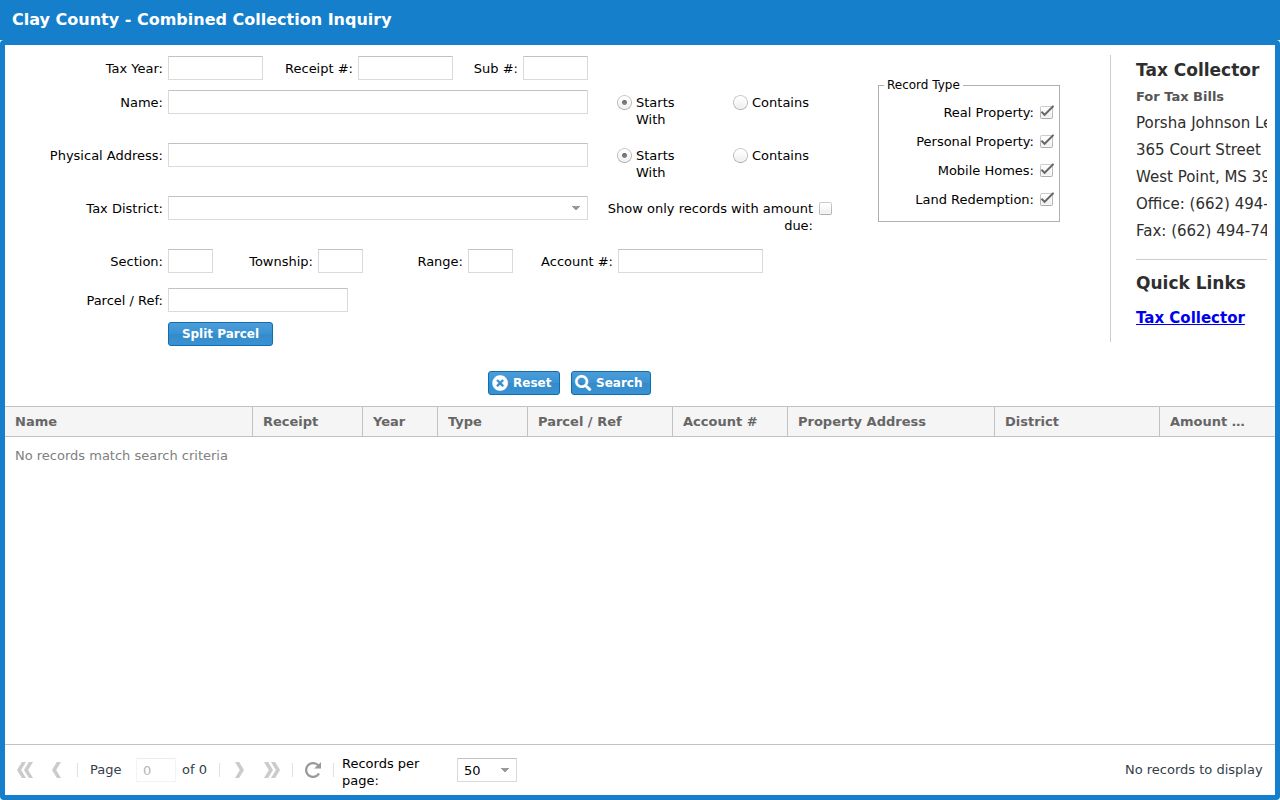
The county's entry screen confirms the right channel. Open a live parcel before assigning meaning to any additional value field.
Clay County Tax Search Fields
The Clay County real-property inquiry accepts several search paths. Lead with one strong key. A broad last-name search may return many parcels. A parcel number is more exact. Physical-address search splits street number, street name, and city into separate parts. Rural land can also be searched by section, township, and range.
| Search field | Entry style | Best use |
|---|---|---|
| Name | Last name first | Find all roll entries for a person, estate, or entity |
| Parcel Number | Preserve spaces and leading zeroes | Match one account across tax and GIS records |
| Section / Township / Range | Three-part PLSS search | Locate rural tracts with weak addresses |
| Street # / Street Name / City | Separate physical-address fields | Start from a known situs address |
The county search screen presents these entry points before any result is selected. Open the official appraisal search to use the live form.
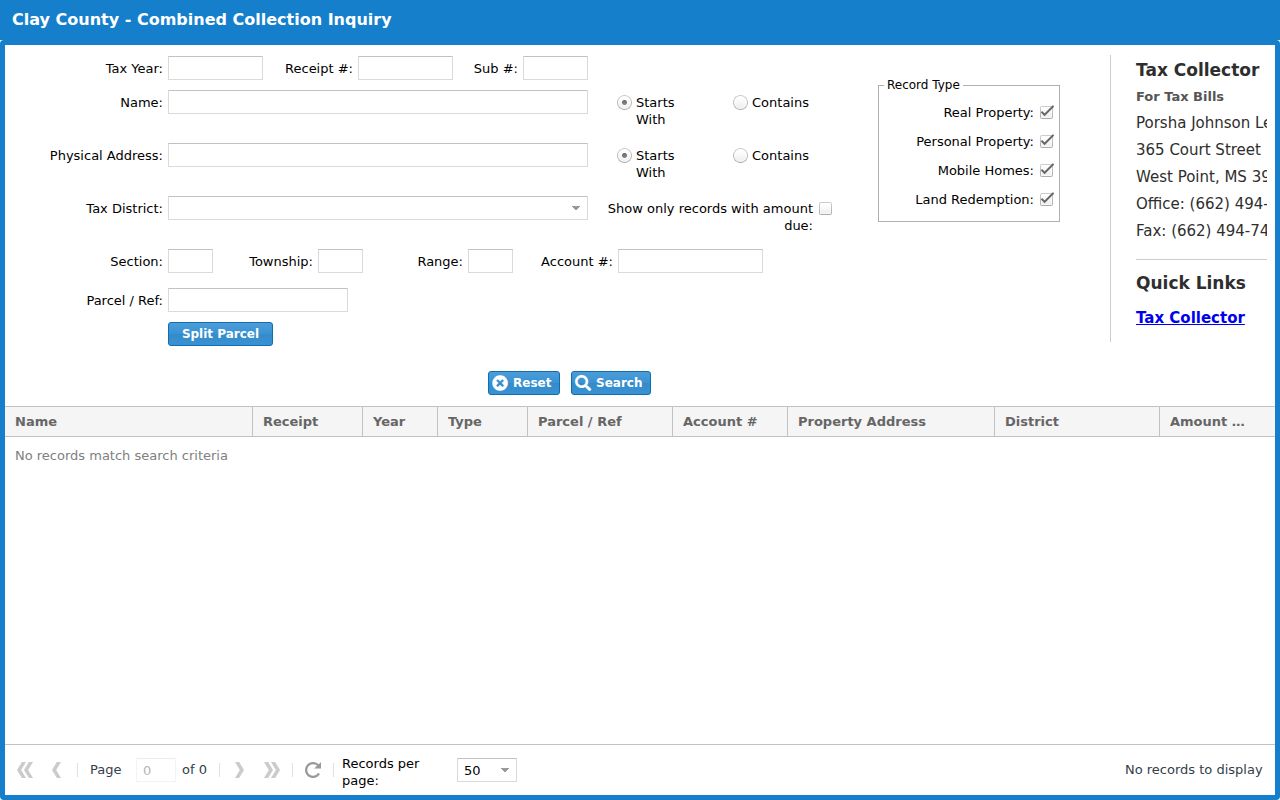
The mix of address, parcel, and PLSS fields matters in a county like this. West Point lots sit alongside farm and timber tracts. One form covers both.
Clay County Homestead Filing
Homestead applications in Clay County run from January 1 through April 1. The county asks each applicant to bring the filed warranty deed. Applicants also need vehicle tag numbers, purchase price, and down payment. Social Security numbers and birth dates are required for the applicant and spouse, along with state photo identification. Proof tied to age or disability applies when relevant. Those are application requirements, not public search fields. Sensitive identifiers should never be copied from a public-facing property tax record.
Check the county homestead instructions for the current filing season. Mississippi enacted property-tax changes in 2025 and 2026. These affect veteran and surviving-spouse rules, filing administration, and some life-estate matters. An old checklist can miss a current rule. An exemption flag helps explain tax treatment, but it proves neither occupancy nor title.
Note: Confirm Clay County's exemption window and document list with the Tax Assessor before a time-sensitive filing.
Find a Clay County Tax Bill
A sound tax lookup ties the appraisal record to one parcel. It ties the collection record to the same parcel. Start at the official roll, never with an unverified payment demand. Read the year before comparing balances. West Point, Prairie, Pheba, and Cedarbluff are postal or locality clues. The parcel and legal description are stronger identifiers. A city label in Clay County property tax records does not prove municipal limits.
- Search by the physical address. Save the full parcel number, tax year, owner spelling, and section-township-range values.
- Open the matching appraisal or land-roll entry. Compare land, improvement, total-value, and exemption fields where shown.
- Check the Tax Collector's current collection information for that parcel and year. Do not treat a prior-year status as the current balance.
- If delinquent, ask whether the parcel was advertised, sold, redeemed, or struck to the state. Confirm each stage with the county record.
- Assessed value
- The statutory portion of true value to which the levy applies.
- Mill rate or levy
- The local rate used with assessed value to calculate tax.
- Homestead exemption
- Qualified relief claimed through the assessor under state and local rules.
- Tax lien
- A legal claim that arises from unpaid property tax and follows a set sale and redemption process.
For help, call the Clay County Tax Assessor/Collector at 662-494-3432 or 662-494-2724, or visit the courthouse downstairs during the published weekday hours of 8:00 a.m. to 5:00 p.m. Bring the parcel number and tax year. A written request under the Mississippi Public Records Act is another route when the portal is down.
Clay County Delinquent Taxes
Real-estate taxes in Clay County come due on February 1. Interest starts February 2. It runs at one percent per month. A $3 publication fee arrives on August 1. The annual tax sale follows on the last Monday of August. The Tax Collector posts the delinquent schedule and runs the sale through GovEase. These milestones matter. A late bill, an advertised parcel, a sold tax lien, and a tax deed are four different situations.
Review the county real-estate tax procedure before you act. Ask about the parcel, the delinquent year, and the sale date. Ask also about the purchaser or struck-to-state status, the redemption amount, and any later tax deed. The Chancery Clerk keeps delinquent records and recorded tax instruments. One more caution belongs here. The Sheriff warned in April 2026 about callers demanding unusual store deposits. That is not a county tax channel. Verify through official phone numbers.
Mississippi Ratios on Clay Taxes
The Mississippi Department of Revenue sorts property into five classes. Class I covers owner-occupied single-family homes. That class is assessed at 10 percent of true value. Class II covers other real property at 15 percent, and personal property matches it. Public utility property and motor vehicles are each 30 percent. The class ratio is not the millage rate. It converts appraised true value into assessed value before local levies apply.
That distinction hits home when two Clay County property tax records show similar full values. The taxable results can differ. Classification, exemptions, and districts change the math. A millage change can move the bill too. Read the assessor entry for value and class. Then check the collector record for the actual amount due.
Clay County Tax Access Channels
Online search is only one route. The Tax Assessor/Collector sees visitors downstairs at the Clay County Courthouse and answers parcel, value, exemption, and collection questions by phone. The Chancery Clerk sits at 365 Court Street. That office keeps delinquent real-estate tax records and related land filings. Have a parcel number ready. Add the address, owner spelling, and tax year. Then name the item you want, whether a roll entry, bill, delinquent schedule, sale record, redemption, or recorded instrument.
Mississippi's Public Records Act backs a narrow written request too. Section 25-61-5 grants inspection and copy rights, subject to exemptions. Section 25-61-7 allows reasonable actual costs. The act allows one working day absent procedures, and no more than seven working days under reasonable ones. Get a cost estimate first. A broad run of records can add up.
Note: A portal outage does not close the record; phone, counter, mail, and a focused written request remain available channels.
Contest a Clay County Assessment
The appeal window rides on the public inspection period. Clay County places the roll before the Board of Supervisors on the first Monday of July and opens it for inspection for two weeks before the first Monday of August. An owner disputing a value files through the Chancery Clerk during that window. The Board hears objections starting the first Monday of August. Save your evidence. Gather the parcel card, tax year, deed, photographs, measurements, and any records showing a factual error or a relevant condition.
Start with a direct question to the assessor. Ask which class, land value, improvement value, acreage, and exemption were used. Name the field you believe is wrong. A changed market opinion carries less weight. A wrong lot size, a duplicate improvement, an incorrect class, or a missed exemption counts for more. The county's appraisal and appeal instructions give the official cycle.
Appeal window. Review the roll during its two-week inspection period and file with the Chancery Clerk before the Board begins August hearings.